
.png)
What is IN4SFS
IN4SFS (Investment Network for Startups Focused on Sustainable Technologies) is a project funded by the European Union through the Horizon Europe programme. The project aims to create an investment network for startups and entrepreneurs developing green and sustainable technologies.
By connecting innovation ecosystems across multiple European countries, IN4SFS facilitates startups’ access to capital, mentorship, and international growth opportunities.
The project runs from 2024 to 2026.
Project stages
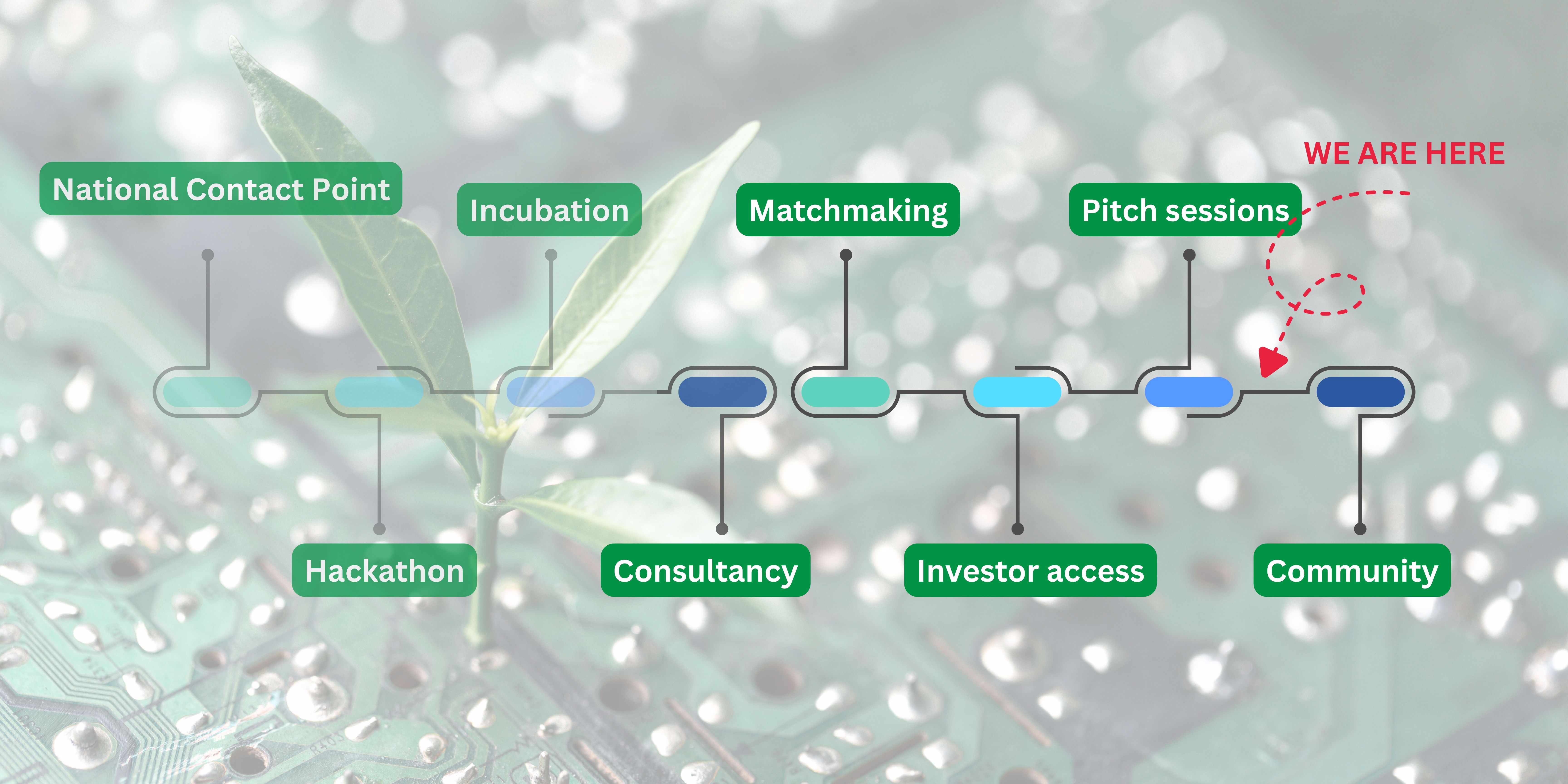
Why join us in 2026?
What have we done so far?
Project
objectives
The project aims to:
- increase startups’ access to international investment
- develop a network of investors specialized in green technologies
- support startups in preparing to attract investment
- stimulate sustainable innovation and solutions to climate challenges
- strengthen collaboration between startup ecosystems across Europe
.png)
|
GreenLeap success stories — Cohort 1
Two founders from the GreenLeap incubation and acceleration programme on what their journey looked like.
|
Re
Recycllux
Sorina Uleia · CEO
Turning marine cleanup into scalable, data-driven impact.
Read the interview ▾
Recycllux is a green tech startup tackling marine plastic pollution through a combination of satellite data, AI and local operational partnerships. As part of the GreenLeap incubation and acceleration program within IN4SFS, Recycllux joined at a relatively advanced stage — yet the program created space for reflection, peer learning and stress-testing assumptions alongside other sustainability-driven founders. A key outcome was a clearer articulation of the company's value proposition, and a shift toward a more customer-centric product development approach. In 2025 the company moved from a validated MVP to an operational, revenue-generating deep-tech business, launching its platform on Google Cloud (Sentinel-1 & Sentinel-2 Earth Observation, AI hotspot detection, blockchain traceability), validated through live pilots on Romania's Black Sea coast with paying customers, and began Mediterranean expansion with a subsidiary in Malta. To date it has secured over €500,000, primarily from grants and Climate-KIC, and plans a €1M seed round in 2026.
What inspired you to start this business, and how does it align with GreenLeap's goals?
Recycllux was born from the desire to fight marine plastic pollution using technology and local partnerships. Our focus on sustainability and circular innovation aligns with GreenLeap's goals.
How did the program impact your approach, and what were the most valuable sessions?
Although we joined GreenLeap at a more advanced stage than many other participants, sharing our experience and receiving feedback from peers helped us reflect on our approach and validate some of our assumptions. The peer-to-peer exchanges and exposure to other sustainable innovation journeys were the most valuable elements of the program.
How has GreenLeap helped you refine your business model or strategy?
GreenLeap encouraged us to better articulate the link between our technology and what's in it for our customers.
Since completing the program, how have you evolved your offering?
We've become more intentional about putting the customer first in our product development. One key takeaway was the importance of deeply understanding the specific needs and value drivers for different customer segments. As a direct result, we brought on a new team member through the Horizon Europe EIC Talent Programme (InnoNext, GA No. 101160467), focused on refining customer segmentation and tailoring our value proposition to strengthen and expand our sales pipeline.
What key steps have you taken to scale after GreenLeap?
We've taken concrete steps to better address market needs, strengthen our pipeline, and prepare for scale-up into the Mediterranean region starting in 2026.
How do you integrate sustainability, and what is your long-term vision?
Sustainability is embedded in everything we do — from using satellite data and AI to target pollution hotspots more effectively, to designing low-emission cleanup logistics with local coastal partners. Our traceability system ensures transparency and accountability in every intervention. Our long-term vision is to become the go-to digital infrastructure for efficient and transparent marine cleanup operations, supporting environmental restoration and compliance with emerging regulations like EPR and CSRD across Europe and beyond.
What advice would you give to startups considering GreenLeap?
GreenLeap is an excellent opportunity for learning, validation, and connection, if you're at an early stage. My advice: come with an open mind and genuine curiosity, and it will definitely pay off.
Ro
RongoDesign
Gabriel Barta · Founder
Rethinking product design through a circular lens.
Read the interview ▾
RongoDesign is a sustainability-driven startup at the intersection of design, innovation and climate responsibility, specializing in the decarbonization of the manufacturing industry by developing materials from industrial residues and mycelium technology. During the GreenLeap program within IN4SFS, the team deepened its understanding of what meaningful sustainability looks like in practice — lifecycle design, carbon accounting and ESG strategy — and reshaped how it defines and communicates impact. The most important shift came at the business-model level: revisiting the supply chain toward ethically aligned partners and adopting a more agile growth strategy. On the product side, core components were redesigned with biodegradable materials and modular principles to extend product life and reduce waste, moving from a linear to a regenerative approach.
What inspired you to start this business, and how does it align with GreenLeap's goals?
RongoDesign was born from a shared passion for sustainable design and a desire to merge creativity with climate action. Our goal has always been to create eco-conscious solutions that are both functional and inspiring. GreenLeap's focus on accelerating green innovation aligned seamlessly with our mission to rethink product development through a circular economy lens.
How did the program impact your approach, and what were the most valuable sessions?
GreenLeap challenged us to be bolder in our sustainability goals. We explored emerging green tech trends, deepened our knowledge of lifecycle design, and connected with thought leaders who redefined our understanding of impact. The workshops on carbon accounting and ESG strategy were particularly transformative, giving us new tools to measure and communicate our environmental footprint effectively.
How has GreenLeap helped you refine your business model or strategy?
GreenLeap helped us evaluate our supply chain and discover new partnerships that align better with our ethical sourcing goals, and helped us adopt a more agile business strategy.
Since completing the program, how have you evolved your offering?
We've significantly evolved our product offering by redesigning core components using biodegradable materials and implementing modular design strategies that reduce waste and extend product life cycles. One key lesson was that sustainability isn't just about material choices — it's about reimagining systems. We shifted from a linear production mindset to a regenerative one, considering not only environmental impact but also the social and economic ripple effects of our innovation choices.
What key steps have you taken to scale after GreenLeap?
We prioritized strategic partnerships and data-driven market expansion. We fine-tuned our customer profiling using insights from the program, which led to more targeted outreach and better alignment with sustainability-conscious consumers.
How do you integrate sustainability, and what is your long-term vision?
Sustainability is woven into our daily operations — from sourcing renewable materials and minimizing studio energy consumption to closed-loop design practices and ethical vendor partnerships. Our long-term vision is to become a pioneer in regenerative design and green technology innovation, championing scalable solutions that empower communities and drive systemic environmental transformation.
What advice would you give to startups considering GreenLeap?
Embrace the journey with an open mind — GreenLeap isn't just about accelerating your startup, it's about redefining your values around sustainability. The most impactful lesson we learned was that meaningful innovation begins with purpose-driven design rooted in long-term ecological and social impact.
|
Interviews after the investor pitch sessions
Four startups that pitched their business to investors, on the pitch experience and what comes next.
|
Io
IoT4Nature
Alexandru Luchiian · Founder & Environmental Intelligence Architect
Turning environmental data into better decisions for cities and communities.
Read the interview ▾
How would you introduce your startup and the problem you solve?
IoT4Nature is an Environmental Intelligence startup that helps cities, organizations and communities transform environmental data into better decisions. We address the challenge that environmental monitoring often stops at collecting data, without providing the insights needed to improve health, sustainability and quality of life.
What is your solution and what makes it relevant?
Our platform combines IoT sensors, cloud analytics, dashboards and Digital Twins to monitor air quality, noise, temperature, humidity and UV exposure. Instead of simply displaying measurements, we translate environmental data into actionable recommendations, reports and decision-support tools for public authorities, businesses and communities — contributing to healthier, more sustainable spaces.
How did you prepare for the pitch session?
I focused on simplifying a technically complex solution into a clear story, restructuring the presentation around a simple journey: Measure → Understand → Improve, supported by practical examples from our public, private and community projects.
What was the main message you wanted the audience to remember?
Environmental monitoring is only the first step. The real value comes from transforming environmental data into intelligence that supports better decisions and measurable impact.
Which part was the most difficult to explain clearly?
Explaining how Digital Twins and AI-based environmental analytics create value beyond traditional monitoring systems, while keeping it understandable for a diverse audience.
What was the most useful question you received?
One of the most valuable discussions was about market scalability — how the same technology can be adapted for different sectors such as smart cities, healthcare, education and commercial buildings.
What feedback was most valuable?
To emphasize the business outcomes even more than the technology itself — focusing on healthier environments, operational improvements and measurable sustainability impact rather than sensors and dashboards.
Did the session help you clarify your business model or market?
Yes. It reinforced that our strongest value proposition is Environmental Intelligence rather than environmental monitoring, and highlighted the importance of presenting clearer commercial use cases and demonstrating how our platform scales across multiple industries.
What will you improve in your pitch or deck?
I will simplify several technical slides, include more customer impact metrics and strengthen the business model, market opportunity and go-to-market strategy. I also plan to better highlight our Digital Twin vision and AI-driven environmental insights.
What is your next step, and what are you looking for?
We aim to expand local projects with municipalities, hospitals, schools and companies while developing our platform to national and international level. We are looking for strategic partners, smart city initiatives, sustainability-focused organizations, research collaborations and investors interested in climate technology, IoT and AI-powered environmental solutions.
Pv
Photovoltaic Windows
Adrian Băisan · Founder / Administrator
Bringing solar energy to apartments through photovoltaic glass.
Read the interview ▾
How would you introduce your startup and the problem you solve?
PhotoVoltaic Windows develops photovoltaic glass solutions for apartments and urban buildings. We address a major gap in the energy transition: apartment residents have very limited access to solar energy, although they represent a large part of the urban population.
What is your solution and what makes it relevant?
Our solution uses semi-transparent photovoltaic windows installed in balconies, façades or glazed areas to produce electricity locally. In our pilot in Bucharest, the energy is used directly for domestic hot water — without inverter, batteries or grid injection — making the system simpler, cheaper and easier to replicate. It combines renewable energy production, reduced energy bills, lower pressure on public heating systems and reduced solar heat gain in summer.
How did you prepare for the pitch session?
We simplified the technical explanation and focused on the real problem: apartments are mostly excluded from solar energy, although they need affordable and practical decarbonisation solutions.
What was the main message you wanted the audience to remember?
Apartments can also enter the solar era.
Which part was the most difficult to explain clearly?
The simplicity of the system: the photovoltaic glass produces DC electricity that can be used directly for a standard electric boiler, without the complexity and cost of a classical PV system with inverter and batteries.
What was the most useful question you received?
One about scalability: how the solution can move from a pilot apartment to larger adoption in apartment buildings, municipalities or residential developers.
What feedback was most valuable?
That we need to communicate the business model and market entry strategy more clearly, not only the technical performance.
Did the session help you clarify your business model or market?
It helped us clarify that the next step is not only technical validation, but also finding the right partners for pilots, certification, installation and market access.
What will you improve in your pitch or deck?
We will make the customer segments, go-to-market strategy, investment needs and measurable impact more visible.
What is your next step, and what are you looking for?
We aim to develop additional pilot projects and partnerships. We are looking for real estate developers, municipalities, housing associations, installers, façade/window companies, boiler manufacturers and investors interested in clean tech for urban buildings.
Qu
Quicks App
Dan Roman · CEO / Co-Founder
A peer-to-peer rental marketplace for a more circular economy.
Read the interview ▾
How would you introduce your startup and the problem you solve?
Quicks is a peer-to-peer rental marketplace that helps people rent everyday items from others nearby instead of buying them for occasional use. We address overconsumption, unused household assets, and the cost of accessing items people only need temporarily.
What is your solution and what makes it relevant?
Quicks enables people to share and reuse existing products, extending their useful life and reducing the need for new purchases. By making local rentals simple, safe and accessible, we support a more circular economy and help reduce waste, storage pressure, and the environmental impact of producing and transporting new goods.
How did you prepare for the pitch session?
We refined the story around the problem, solution and market opportunity, while making the sustainability impact easier to understand, using real-life examples of items people commonly need but do not necessarily need to own.
What was the main message you wanted the audience to remember?
Access can be more efficient than ownership. Many products sit unused most of the time, and Quicks gives people a practical way to unlock that value while supporting more sustainable consumption habits.
Which part was the most difficult to explain clearly?
Balancing the marketplace business model with the sustainability impact in a short pitch format — showing both the commercial opportunity and the environmental relevance without making the message too complex.
What was the most useful question you received?
No single question stood out; the discussion was useful mainly because it helped us see where the pitch was clear and where we needed to sharpen the message for different audiences.
What feedback was most valuable?
To adapt the pitch more clearly to the target audience and make the opening hook stronger. The first seconds are very important for catching attention and framing the opportunity.
Did the session help you clarify your business model or market?
Yes. It helped us communicate Quicks not only as a rental marketplace, but as a circular economy solution, and reinforced the importance of explaining our target users, trust mechanisms and growth strategy concisely.
What will you improve in your pitch or deck?
We will make the opening stronger, adapt the message to the audience, make the impact story more concrete, and simplify parts of the deck so the business model, market opportunity and investment case are easier to follow.
What is your next step, and what are you looking for?
We will keep growing the platform, improve the user experience, and build stronger local supply and demand. We are raising EUR 150,000 and looking for investors interested in circular economy, consumer marketplaces and sustainable urban living.
eM
eMobility Research Hub
Prof. Bogdan Varga · Director | Alexandru Bara · Research Assistant
Research and consultancy for sustainable and intelligent mobility.
Read the interview ▾
How would you introduce your organisation and the problem you solve?
eMobility Research Hub is a consultancy and research-oriented SME focused on sustainable and intelligent mobility. We support cities, public transport operators and other stakeholders in identifying and implementing solutions that reduce transport-related emissions and improve urban mobility systems.
What is your solution and what makes it relevant?
We provide specialised expertise, research and consultancy in areas such as green hydrogen, electric mobility, intelligent transport systems and sustainable public transport — supporting the transition towards low-emission and more energy-efficient mobility.
How did you prepare for the pitch session?
We researched the project and its objectives, and focused on how to present a highly technical subject to an audience that might not be familiar with the field — communicating the idea clearly, accessibly and concisely.
What was the main message you wanted the audience to remember?
The need to reduce CO₂ emissions through the development and implementation of green hydrogen and other sustainable mobility solutions.
Which part was the most difficult to explain clearly?
Explaining exactly what our organisation does, particularly because our activity combines research expertise with the role of a consultancy SME in the sustainable and intelligent mobility sector.
What was the most useful question you received?
The challenge to explain more clearly that we provide specialised expertise and consultancy in sustainable and intelligent mobility, rather than offering only one specific technological product.
What feedback was most valuable?
To present the team members more clearly and to explain our core idea, services and added value in a more straightforward and structured way.
Did the session help you clarify your business model or market?
Yes. It helped us better position our expertise and consultancy services, define our target market and communicate the potential impact of our work more effectively.
What will you improve in your pitch or deck?
We will improve the structure and clarity, give a more precise explanation of our services and business model, introduce the team more clearly and better highlight the concrete impact and benefits of our work.
What is your next step, and what are you looking for?
We will further develop our consultancy and research activities and establish new collaborations with municipalities, SMEs, universities and public transport operators. We are interested in partners and opportunities focused on reducing urban CO₂ emissions, decarbonising public transport fleets and implementing sustainable and intelligent mobility solutions.
Project Consortium
The IN4SFS project is implemented by a consortium of organizations active in innovation, investment, and startup development.
There are 7 partners from 7 European countries: Turkey, Greece, Romania, France, the Netherlands, Denmark, and Belgium.
The partners contribute to:
- developing the investment network
- organizing programs for startups
- facilitating international connections
Partnership:
- Fonden Creative Business Cup – Denmark
- EGE Teknopark – Turkey
- SEGE – Greek Association of Women Entrepreneurs – Greece
- North-West Regional Development Agency (ADR Nord-Vest) – Romania
- CleanTech Business Institute (CBI) – France
- Reijtenbagh Rene / Reijtenbagh Projektpartner – Netherlands
- EAIC – European Association of Innovation Consultants – Belgium